Give the work to something that has read everything.
The work goes to the agent. The judgement stays with you. Every run reads your own record and comes back for a signature before it counts.
Request a Demo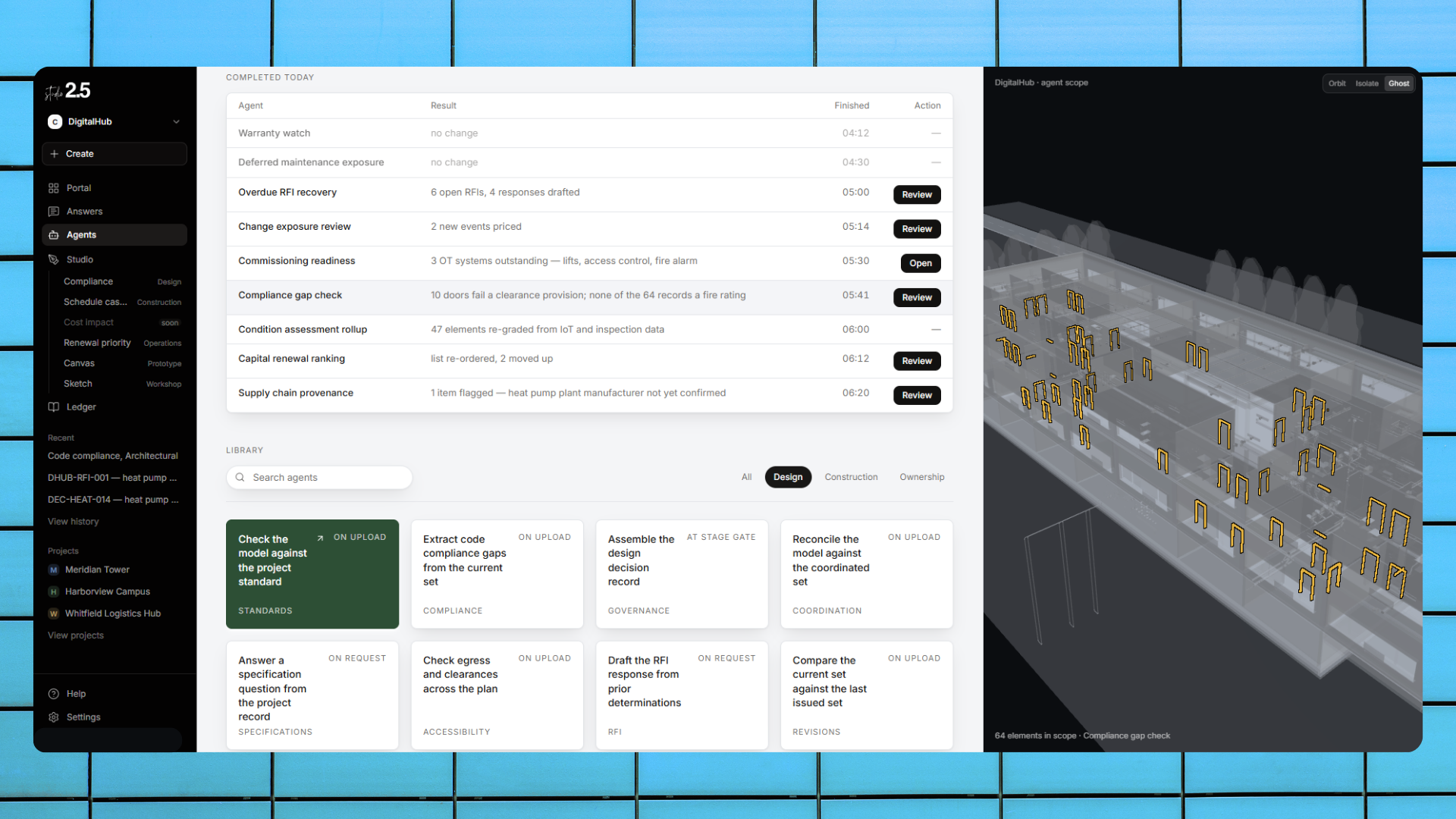
Run more high-performing work than you have people for.
Run them in parallel
Hand off one job or ten. Agents split the work and run at the same time, so the output comes back together.
Set them on a schedule
Reports and reviews that run overnight or every Monday, so the work is waiting for you rather than queued behind you.
Give them anything you have
Models, drawings, contracts, schedules, photographs, sensor readings. Work comes back as a report, a table, a marked-up model, or whatever the job needs.
You keep the judgement.
See the plan first
The agent shows you what it intends to do and what it will read. Narrow the scope or stop it before anything runs.
It comes and finds you
When something needs a person, the agent stops and asks. You are brought in on the decisions rather than the steps.
Everything is checkable
Every claim carries its source and every step is logged. You can see how it got there before you put your name on it.
Timeline of a single agent run, six moments alternating between the agent and you: 1. Plan proposed: the agent. 2. Approved: you. 3. Steps running: the agent. 4. Stopped, needs you: you. 5. Resumed: the agent. 6. Signed: you.
Built the way you decide.
Build your own
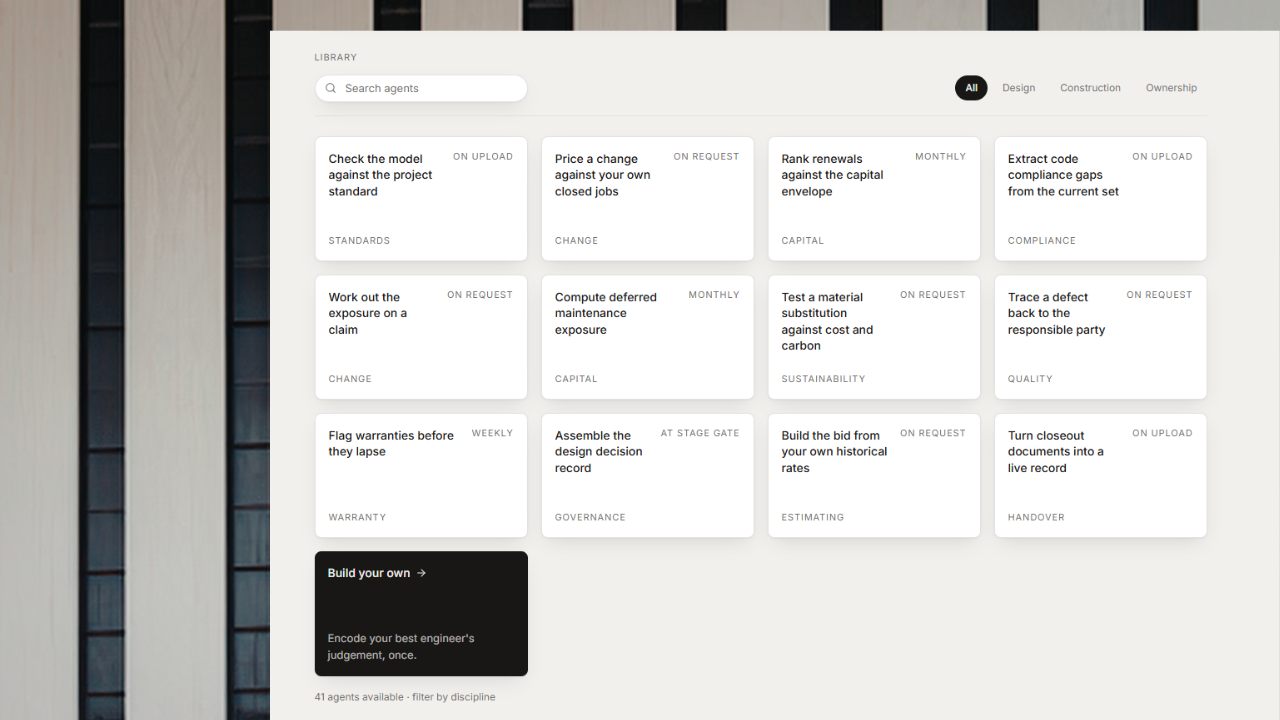
Describe the job once and keep the agent. It runs the same way every time, so you are not re-explaining your standards on every project.
It remembers how you decided
Every determination your people make goes into the record, and agents work from it. What you settled last year is the starting point this year.
It reaches your systems
Secure access to the cost, document, model and field systems your teams already use, so agents can find what they need without anyone exporting anything.
When one package runs behind, do you offer a phased handover or hold for a single completion date?
The same question, answered differently by two organizations, because each draws on a different history of past determinations.
Offer the phased handover. Getting the finished packages into use outweighs the added commissioning complexity, and the delayed package does not have to hold up the rest.
Phased handover is acceptable when the incomplete package carries no life-safety scope.
Feb 2023 · Risk Committee
Partial occupancy is preferred over holding a finished building empty.
Sep 2023 · Owner's Representative
Commissioning can run alongside occupancy of the completed packages.
Nov 2023 · Commissioning Lead
A delayed package proceeds on its own once its own scope is substantially complete. (the determination behind this difference)
Jan 2024 · Program Director
Hold for a single completion date. A split handover opens two warranty clocks and two punch lists, and this organization has judged that heavier than the schedule it saves.
A single completion date protects one warranty period rather than several.
Mar 2023 · Risk Committee
Split handovers have produced duplicate punch-list effort on past projects.
Aug 2023 · Construction Director
Occupancy ahead of full commissioning is not accepted on this portfolio.
Oct 2023 · Owner's Representative
A schedule slip on one package holds the handover of the whole building. (the determination behind this difference)
Dec 2023 · Program Director
How teams use agents.
Price a new project against what your own past projects actually cost, down to the quantities and rates that drove the number.
Check a design or a submittal against the code and the contract terms that govern it, and show which clause each finding came from.
Decisions arrive with the evidence gathered and the alternatives priced. Faster because the work of preparing them is done.
Run the whole-life cost of an asset or a portfolio, capital and operating together, with the condition and replacement assumptions visible.
Track cost, schedule and risk across every package, and get told which packages are in trouble before the next report.