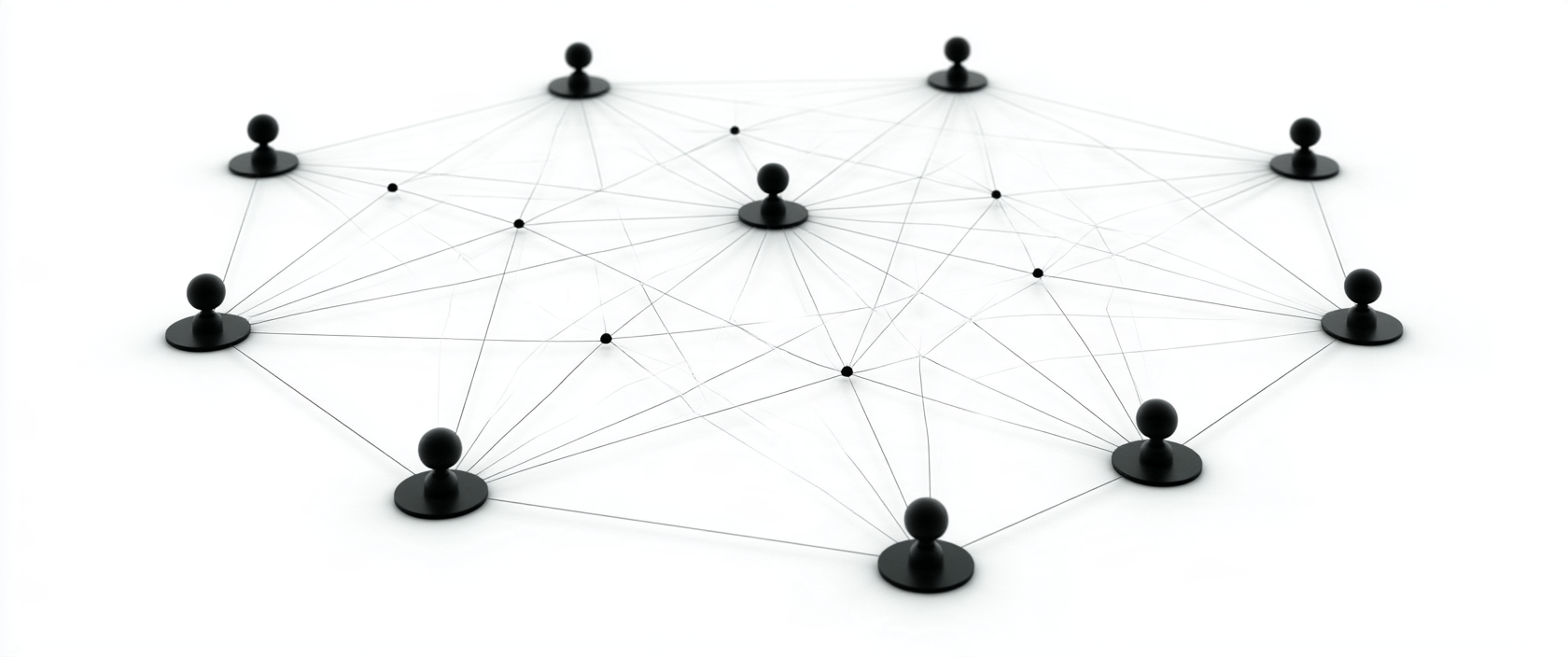
Become a frontier organization.
The organizational side of AI transformation, so your teams keep adapting as the technology changes.
What does it look like.
A company that changed shape around what it knows.
The answer sits with whoever has been here longest.
Anyone can get the answer. It does not depend on who is in the room.
A change passes through nine people before it reaches the one who decides.
The context arrives with the change. A person still decides, sooner.
Teams are structured to move information upward.
Teams are structured around the work, because the record moves the information.
Every project starts over. The last one's lessons are in somebody's head.
Every project starts from what the last one learned.
When someone retires, what they knew goes with them.
What they knew was written down as they worked.
The structure is what changes
Most AI work leaves the structure alone. Everyone gets a tool, the work goes a little faster, and the company is shaped exactly as it was. The bigger change is structural. Once the record carries the context, fewer people are needed to carry it, and the organization can be built differently.
One RFI, today: 8 handoffs, 19 days waiting, 27 days elapsed. The same RFI, after: 2 handoffs, 1 day waiting, 3 days elapsed. Both drawings are made by the people who run the workflow, and they set the numbers. The coordinator is on their own work now.
What a world model transformation looks like, over time.
Your first agents run overnight against the record. Someone reads what they produced in the morning.
Every team has agents doing its routine work. Your people build them and check what comes back.
Agents price a job against what your past jobs cost. A person reads the number and makes the call.
Agents handle the work between the decisions. Your people spend the day on the decisions.
Nobody hands off here
Most organizations hire three firms for this. One writes the strategy, one sells the software, one runs the training. We do all three.
The usual arrangement: Strategy firm: Writes the roadmap, Software vendor: Sells the tool, Change management: Runs the training, joined by a Nobody owns this between each. Here: studio 2.5. Maps the workflow and builds what runs it. Stays while it goes into use..
Five stages, one at a time.
Five stages, and at every one of them we are working on five things at once. Change one of them and leave the other four alone, which is what most programs do, and it stalls.
A workshop with your leaders. What matters, and which decisions this has to serve. Agreed before anything is designed.
organizational goals, a prioritized problem tied to value, a phased roadmap, an investment framework you can take to your board, and a baseline taken before anything starts, so there is something to measure against.
Your workflows and your data as it actually is. Where the authoritative record sits, and what condition it is in.
a map of your asset information across the systems holding it, an assessment of quality and ownership, a proposed information architecture, and the workflows worth building first.
Three to five real workflows, built with your people at the table, running on your own data. Short enough that you learn from what breaks.
the workflows running on your record, the determinations they produced, and a pilot design for what comes next.
The workflows go into real use, with governance and a record of what was decided. Read only to start, shaped by your security team.
everything the record has accumulated, in open formats, on your storage.
More workflows, and the structure underneath them. This is where an organization stops running experiments and starts running differently.
| AlignHalf a day to two days | GroundTwo to four weeks | LabFour to six weeks | DeployInto real use | ScaleOngoing | |
|---|---|---|---|---|---|
| TechnologyThe record and the systems agents reach | |||||
| GovernanceWhat an agent may do without a person, and who signs | |||||
| SkillsWhat your people will be asked to do that they have not done before | |||||
| CommunicationWho hears about this, and from whom | |||||
| StructureWhich roles change and which handoffs stop existing |
Every area needs its own champion.
This does not survive on one person. Each area needs somebody who owns the workflows in it, and they are not always who you would expect. They are the people others already go to when something is broken.
They build the workflow with us.
Their own teams come to them first.
The training is ours to begin with and theirs by the end.
How you will know it worked
Every objective gets a measure and a target, against a baseline taken before we start. Your people set them, because they know how long the work takes today.
Are people actually using it?
- People running workflows each weekcounted
- Workflows in regular usecounted
- Champions trainedcounted
- Determinations writtencounted
Is the work faster, and does it hold up?
- People running workflows each weekstops mattering
- Elapsed time on the workflows we measuredagainst baseline
- Rework and repeat questionsagainst baseline
- Time to assemble evidence for a decisionagainst baseline
Are we winning work we would not have won?
- Elapsed time on a workflowstops mattering
- Decisions defended without a searchcounted
- Bids priced against your own historycounted
- What the record holds that nobody in the organization knewjudged
The baseline is taken in Align, before anything is designed. Without it there is nothing to compare against later, and every claim about improvement is a matter of opinion.
Start with a half day.
Half a day with your leaders to work out which of these you already have and which one to take first. Then two weeks on one real workflow.
Everything produced in any phase is yours. If you stop after ground, you keep the architecture and the map, and you can take them to anyone.